
EthicsPortal
Whistleblowing channel hosted on Hetzner in Germany. Flat €60/month plan, with a published DORA evidence set.
Rubric score
47 / 50
Evidence tier P+R+H
Reviewed across the public site plus the reporter and handler environments.
Facts
- Headquarters
- Poland
- Hosting
- Hetzner, Nuremberg, Germany
- Pricing
- €60/month, or €41.67/month billed annually (€500/year)Single plan. Unlimited users, reports, file uploads.
- Languages on reporting form
- 14
- Founded
- 2025
- Ownership
- Private
- Employees
- 2-10
- Product scope
- Standalone whistleblower product
- Encryption posture
- At rest
Measured, not published
Established by checking the vendor's own infrastructure rather than by reading its marketing. Every figure here can be reproduced from the links given.
- DMARC policy
- Enforced (quarantine)
- DNSSEC
- Unsigned
Capabilities
- Anonymous reporting ✓
- Multi-channel intake ✓
- Public API ✗
- Free trial ✗
- Two-factor authentication ✓
- Audit log ✓
- EU Directive 2019/1937 (vendor claim) ✓
✓ published by the vendor · ✗ vendor states it is not offered · — not published either way
Certifications and national law
Certifications
- ISO 27001 (Hetzner hosting)
National laws referenced
- Germany (HinSchG)
- France (Loi Waserman)
- Italy (D.Lgs. 24/2023)
- Spain (Ley 2/2023)
- Poland (Act of 14 June 2024)
- Bulgaria (Whistleblowing Act, in force 4 May 2023)
- Greece (Law 4990/2022)
- Romania (Legea nr. 361/2022)
- All 27 EU member states — a dedicated /whistleblower-laws/<country>/ page exists per state, citing the official law text
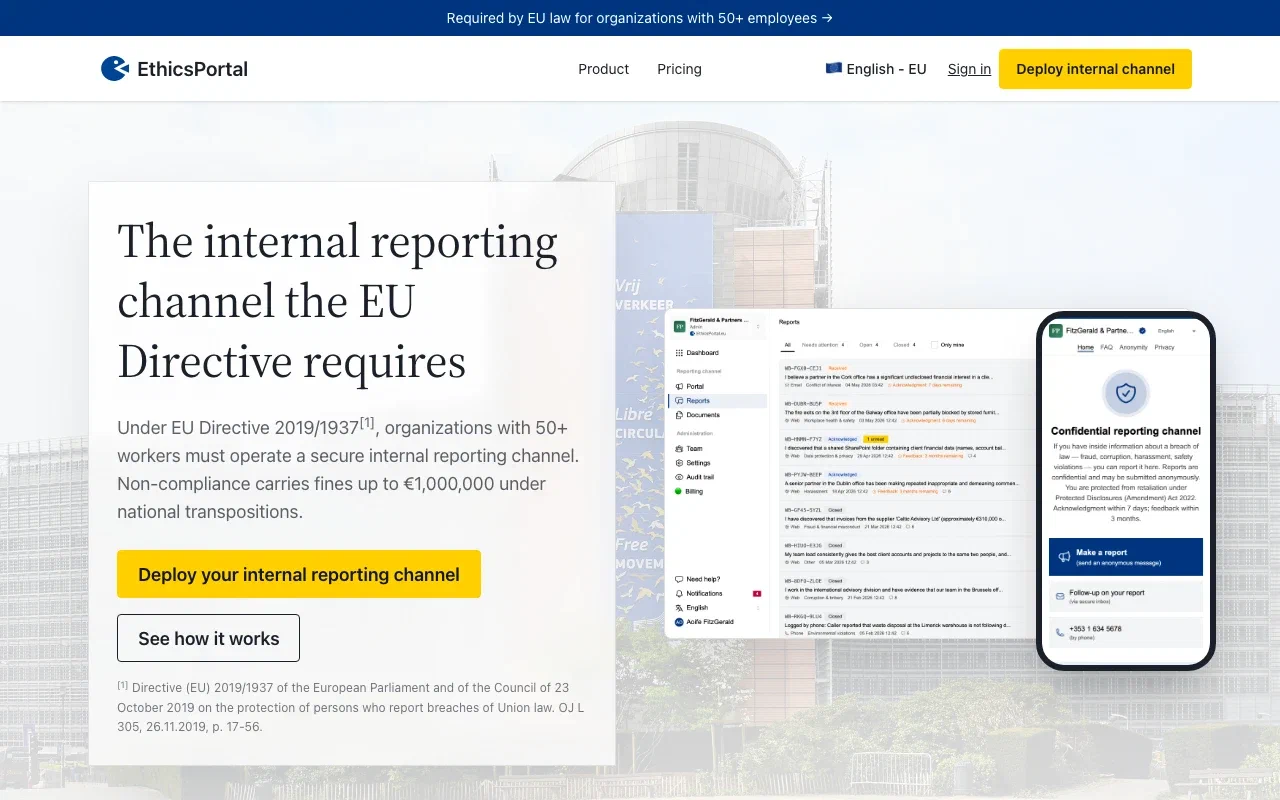
EU organisations (50+ employees) wanting flat-rate, EU-hosted reporting without enterprise sales engagement — including financial entities that need DORA Article 30 contract terms and register-of-information fields from a whistleblowing vendor.
Distinctive features
- Flat €60/month regardless of headcount, users, or report volume
- EXIF, GPS, and author metadata stripped from uploads automatically
- Article-by-article mapping of features to Directive 2019/1937, plus a dedicated public page for each of the 27 EU member-state transpositions
- In-portal oral reporting (Art 9(2)(b)) with automatic voice anonymization — the reporter's raw voice is pitch-shifted and the original audio purged, never persisted past processing
- Published DORA evidence set for financial-entity buyers — Article 30(2) and 30(3) provisions listed with status, register-of-information fields under Implementing Regulation (EU) 2024/2956, ICT service supply chain named, and a signable contractual addendum
Notable
- Single flat plan; pricing does not vary by employee count, report volume, or user count.
- Reporter and handler UI are available in English, Bulgarian, German, Greek, Spanish, French, Croatian, Italian, Dutch, Polish, Portuguese, Romanian, Slovenian, and Luxembourgish (14 locales total; 13 EU official languages plus Luxembourgish).
- Vendor publishes an article-by-article mapping of features to EU Directive 2019/1937, plus a dedicated public page at
/whistleblower-laws/<country>/for each of the 27 EU member-state transpositions, citing official law text and external authorities. - File uploads are stripped of EXIF, GPS, and author metadata before storage.
- No reporter IP addresses are stored; rate limiting uses one-way hashes.
- Personal data is encrypted in transit (TLS); sensitive fields — report descriptions, reporter contact details, and message bodies — are encrypted at rest.
- Append-only audit trail logs every action with timestamp, actor, and action type; the complete audit log of submissions, status changes, messages, assignments, and report views is visible to handlers on each report.
- Two-factor authentication available for handler and admin accounts, with an onboarding step prompting setup.
- Reporter access uses two factors: a case reference (format
WB-XXXX-XXXX) plus a 6-digit passcode chosen by the reporter at submission. The passcode is stored only as a hashed digest and cannot be recovered. The follow-up inbox and message-posting are gated on the passcode check; no account creation required. Reporters can also download a PDF copy of their own report from the follow-up portal (audit-logged). - Configurable data retention: 12, 24, 36, 48, or 60 months, with automatic deletion of expired closed reports.
- 7-day acknowledgement and 3-month feedback deadlines tracked automatically with overdue notifications and a lifecycle stepper UI.
- Closure reason captured as a structured outcome (action taken, no action needed, outside reporting scope, referred to external authority, withdrawn) aligned with Directive Art 9(1)(c) feedback obligations.
- Oral reporting (Directive Art 9(2)(b)) is supported directly in the portal: reporters can record a voice message at submission. Anonymization is always-on and irreversible — the audio is pitch-shifted, only the altered clip is attached, and the original is purged, so the reporter’s true voice never persists past processing. The pipeline fails closed: until conversion succeeds the recording is hidden from handlers, and on permanent failure the raw audio is purged rather than retained.
- Handlers can set a case priority (low, normal, high, urgent) during assessment; the priority shows as a badge on the report list, every change is audit-logged, and the compliance report includes a breakdown of reports by priority.
- Admins can export an organisation-level compliance report PDF directly from the dashboard.
- Handlers can manually log reports received by phone, email, or in person.
- Report categories are mapped to the Directive’s Art 2(1) Union-law domains: each category carries a directive (with article reference) or national tag, the article surfaces as a badge on the handler-facing report detail, and reporters continue to choose from plain-language groups.
- Structured intake questionnaire: five optional, Directive-aligned questions — relationship to the organization (Art 4 personal scope), how the reporter knows, when/how often it happened, whether it was reported before, and whether the reporter fears or faces retaliation (Art 19) — presented as a skippable guided step on the reporter form so anonymity is never compromised by a required answer. Answers are encrypted at rest, shown to handlers and in the PDF export, and a retaliation concern is surfaced as a prominent urgency badge. The same questions are available when a handler logs an offline (phone/in-person) report.
- Three membership role tiers: member (handler), admin, and viewer — a read-only seat for auditors and external legal counsel that can see every report and the full audit trail but cannot act on a case or manage the organisation.
- Organization-level GDPR Art 20 data export: an admin can request a ZIP of the full tenant dataset (reports, messages, attachments, with encrypted fields decrypted for portability); the request and the download are both audit-logged, access is admin-only, and the ZIP auto-purges after 7 days.
- Deleting an organisation that holds reports is a retention-aware soft-delete, not an instant wipe: the org disappears for users immediately while its reports ride out their per-portal retention windows and are auto-purged afterward, preserving the Directive’s retention obligation. Orgs with no reports still hard-delete immediately.
- SCIM 2.0 user provisioning: an organization can connect its identity provider (e.g. Okta, Microsoft Entra ID) to provision case handlers and automatically deprovision them when they are removed from the directory. Admins generate, rotate, and enable or disable a per-organization token and choose the default role for provisioned users.
- SAML 2.0 single sign-on: an organization can connect its identity provider (e.g. Okta, Microsoft Entra ID) so its team signs in through it. SSO is configured per organization and can cover one or more email domains; enforcement (requiring SSO for those domains) and just-in-time provisioning of accounts on first sign-in are both optional. Magic-link sign-in remains available when SSO is not enforced. SSO authenticates logins while SCIM provisions accounts — the two together are the standard enterprise-identity pairing.
- No public reporting API or third-party integrations published; the SAML SSO and SCIM endpoints are scoped to authentication and identity provisioning respectively.
- Hosted in Hetzner’s Nuremberg data-centre park, which holds ISO/IEC 27001:2022 certification (audited by SOCOTEC) covering infrastructure, operation, and customer support. EthicsPortal itself is not separately ISO 27001 certified.
- Publishes an ISO 37002:2021 guidance-alignment map (/iso-37002/) mapping the standard’s operating clauses to shipped features, plus an ISO 27001 Annex A self-assessment. ISO 37002 is a guidelines standard, so this is alignment, not certification.
- Published DPA grants the Controller an explicit right to object to subprocessor changes (§6.4, 30-day notice + termination remedy) and commits to 72-hour breach notification (§6.6).
- Publishes a DORA page (/dora/) for financial entities: the service is classified as type S19 (Cloud services: SaaS) in the ICT-services taxonomy used by the register of information, with the provider-side register fields supplied under Article 28(3) DORA and Implementing Regulation (EU) 2024/2956, and the ICT service supply chain named rather than summarised.
- Article 30(2) baseline provisions and Article 30(3) extended provisions (for ICT services supporting a critical or important function) are each listed requirement-by-requirement with status and location, and a signable contractual addendum is published at /dora-addendum/ covering subcontracting, audit and authority cooperation, incident assistance, exit and transition.
- Concentration risk is stated plainly on the same page rather than omitted: report data sits with a single IaaS subcontractor in one region, so it can enter the customer’s Article 29 assessment.
- Zero-AI commitment codified in DPA §6.10 and on the public subprocessor list: no LLM or AI inference provider is in the data chain.
- Accessibility statement at /accessibility/ declares WCAG 2.2 Level AA and EN 301 549 V3.2.3 conformance posture, with non-conformances enumerated and a detailed conformance table at /en-301-549-conformance/.
- Users can review and revoke their own active sessions; each session records when it was last seen so stale devices are identifiable.
Scoring review - 2026-06-21
Reviewed across the public site plus the reporter and handler environments, under the 25-criterion rubric (v2_25_criteria).
Base score: 47 / 50 in the France, Bulgaria, Greece, and Romania contexts. Country bonuses: France 5 / 8, Bulgaria 6 / 6, Greece 4 / 6, Romania 6 / 6, Spain 5 / 6, Belgium 5 / 6.
| Category | Score | Max |
|---|---|---|
| A. Legal compliance | 16 | 16 |
| B. Reporter experience (BG/FR/GR/RO) | 10 | 10 |
| C. Handler experience | 10 | 10 |
| D. Security | 6 | 8 |
| E. Commercial | 5 | 6 |
What caps the base score:
- D19 — ISO 27001 of EthicsPortal itself: only Hetzner infrastructure is certified.
- A7 — hash-chained audit log: append-only at the database level, but not hash-chained.
- E24 — free trial: pay-first with 30-day money-back; no upfront self-serve trial.
Buyer fit: Bulgaria 53 / 56, France 52 / 58, Greece 51 / 56, Romania 53 / 56. Spain and Belgium each gain from the in-language reporter UI now live. Across markets the remaining deltas are data-residency fit (Germany-only hosting, no per-country region) and the three base-capping gaps above.
Frequently asked questions about EthicsPortal
Answers derived from vendor-published materials dated on this page.
Is EthicsPortal suitable for SMEs under 250 employees?
Which national whistleblower laws does EthicsPortal explicitly reference?
Does EthicsPortal process whistleblower report content with AI?
Similar to EthicsPortal
Other platforms in the directory with overlapping pricing model, certifications, or procurement path.
 Hintbox
German whistleblowing platform with flat Basic/Premium pricing from EUR 49/month, 30 languages, AI translation, and ISO 27001 certification.
Hintbox
German whistleblowing platform with flat Basic/Premium pricing from EUR 49/month, 30 languages, AI translation, and ISO 27001 certification. LegalTegrity
German SME whistleblowing platform. Tiered pricing €49–€165.83/month by employee count.
LegalTegrity
German SME whistleblowing platform. Tiered pricing €49–€165.83/month by employee count. whistle.law
German HinSchG-focused whistleblowing platform with published EUR 50-150/month pricing and public GDPR/security documentation.
whistle.law
German HinSchG-focused whistleblowing platform with published EUR 50-150/month pricing and public GDPR/security documentation.Ashio Estonian-registered whistleblowing SaaS with 18 site locales, a law page per market, client-side encryption, and one €23–30/month plan that includes every feature.
Sources and verification
Every fact on this page comes from EthicsPortal's own published materials. These are the pages that were read, and the date they were read.
- Last verified
15 of the vendor pages cited below has changed since this entry was verified. What this means
Cited pages last re-fetched
- ethicsportal.eu/ (opens in new tab)
- ethicsportal.eu/pricing/ (opens in new tab)
- ethicsportal.eu/compliance/ (opens in new tab)
- ethicsportal.eu/product/ (opens in new tab)
- ethicsportal.eu/dpa/ (opens in new tab)
- ethicsportal.eu/dpia/ (opens in new tab)
- ethicsportal.eu/subprocessors/ (opens in new tab)
- ethicsportal.eu/trust/ (opens in new tab)
- ethicsportal.eu/security/ (opens in new tab)
- ethicsportal.eu/iso-37002/ (opens in new tab)
- ethicsportal.eu/iso-27001/ (opens in new tab)
- ethicsportal.eu/caiq/ (opens in new tab)
- ethicsportal.eu/dora/ (opens in new tab)
- ethicsportal.eu/dora-addendum/ (opens in new tab)
- ethicsportal.eu/industries/financial-services/ (opens in new tab)
- ethicsportal.eu/incidents/ (opens in new tab)
- ethicsportal.eu/accessibility/ (opens in new tab)
- ethicsportal.eu/whistleblower-laws/ (opens in new tab)